Retirement Planning Strategy: Combining Equity Funds with PPF
Retirement planning becomes more effective when long-term equity investments are combined with the stability of PPF. Explore a disciplined strategy to build a retirement corpus through equity SIPs and annual PPF investments.
Aparna Phakade Pawar
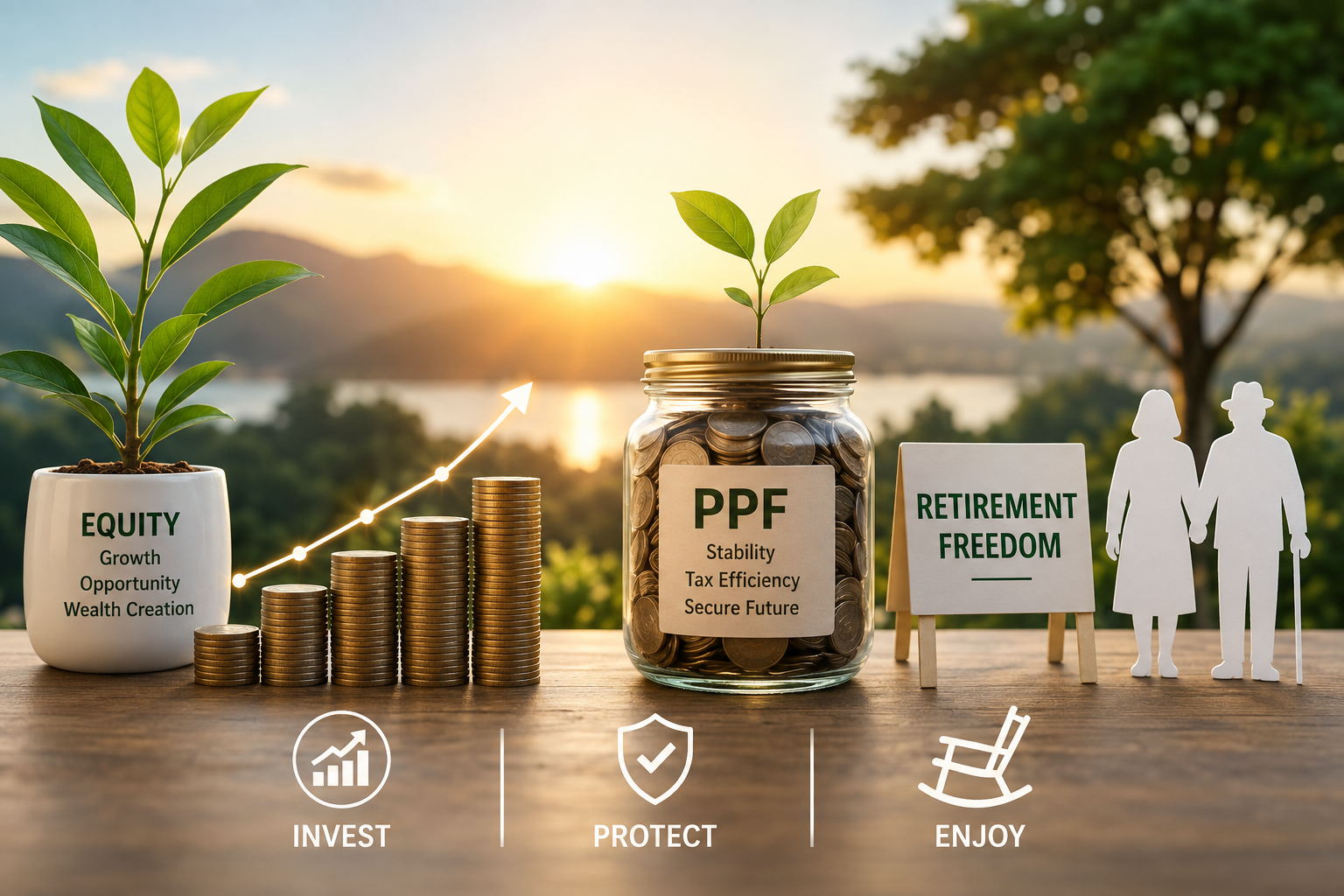
Retirement planning works best when started early. For example, if an individual begins investing at age 25 and continues until age 60, a long investment horizon of 35 years allows for meaningful wealth creation through disciplined investing.
One possible strategy is to combine long-term equity investments for growth with a debt allocation through a Public Provident Fund (PPF) to build stability and tax-efficient income.
Investor Approach
An investor may consider allocating investments based on risk appetite through diversified equity mutual funds such as:
Flexi Cap Fund for diversified market exposure
Mid Cap Fund for higher growth potential with moderate-to-high risk
Small Cap Fund for aggressive long-term growth with higher volatility
Retirement Fund for goal-based retirement investing
Suggested Process
Start a monthly SIP of ₹15,000 towards the retirement goal through suitable equity mutual funds.
After one year, consider redeeming up to ₹1.5 lakh from accumulated equity investments (subject to market conditions, capital gains taxation, and portfolio performance).
Invest ₹1.5 lakh in the PPF account at the beginning of the financial year (preferably till 4 April to maximize annual interest accrual).
Continue this disciplined process over the long term while reviewing allocation periodically.
*Assumptions Used in Illustration*
Equity portfolio return assumption: 12% CAGR
SIP amount: ₹15,000 per month (with periodic enhancement of 5% after every 5 years)
Annual PPF investment: ₹1.5 lakh (current maximum permissible limit)
PPF interest rate assumption: 7.1% per annum
| Year | Investment | Future Value | PPF | PPF FV |
|---|---|---|---|---|
| 1 | ₹ 1,80,000 | ₹ 1,92,140 | ||
| 2 | ₹ 1,80,000 | ₹ 4,08,648 | ₹ 1,50,000 | ₹ 1,60,650 |
| 3 | ₹ 1,80,000 | ₹ 4,83,591 | ₹ 1,50,000 | ₹ 3,32,706 |
| 4 | ₹ 1,80,000 | ₹ 5,68,039 | ₹ 1,50,000 | ₹ 5,16,978 |
| 5 | ₹ 1,80,000 | ₹ 6,63,196 | ₹ 1,50,000 | ₹ 7,14,334 |
| 6 | ₹ 1,98,000 | ₹ 7,70,422 | ₹ 1,50,000 | ₹ 9,25,701 |
| 7 | ₹ 1,98,000 | ₹ 8,91,247 | ₹ 1,50,000 | ₹ 11,52,076 |
- 1
- Investment
- ₹ 1,80,000
- Future Value
- ₹ 1,92,140
- 2
- Investment
- ₹ 1,80,000
- Future Value
- ₹ 4,08,648
- PPF
- ₹ 1,50,000
- PPF FV
- ₹ 1,60,650
- 3
- Investment
- ₹ 1,80,000
- Future Value
- ₹ 4,83,591
- PPF
- ₹ 1,50,000
- PPF FV
- ₹ 3,32,706
- 4
- Investment
- ₹ 1,80,000
- Future Value
- ₹ 5,68,039
- PPF
- ₹ 1,50,000
- PPF FV
- ₹ 5,16,978
- 5
- Investment
- ₹ 1,80,000
- Future Value
- ₹ 6,63,196
- PPF
- ₹ 1,50,000
- PPF FV
- ₹ 7,14,334
- 6
- Investment
- ₹ 1,98,000
- Future Value
- ₹ 7,70,422
- PPF
- ₹ 1,50,000
- PPF FV
- ₹ 9,25,701
- 7
- Investment
- ₹ 1,98,000
- Future Value
- ₹ 8,91,247
- PPF
- ₹ 1,50,000
- PPF FV
- ₹ 11,52,076
| Year | Investment | Future Value | PPF | PPF FV |
|---|---|---|---|---|
| 34 | ₹ 3,18,881 | ₹ 2,67,90,990 | ₹ 1,50,000 | ₹ 1,94,98,127 |
| 35 | ₹ 3,18,881 | ₹ 3,02,11,874 | ₹ 1,50,000 | ₹ 2,10,43,144 |
| Investment | ₹ 85,38,454 | |||
| Equity FV | ₹ 3,02,11,874 | |||
| PPF FV | ₹ 2,10,43,144 | |||
| Retirement Corpus | ₹ 5,12,55,018 | |||
| Tax Free Interest per year after retirement | ₹ 14,94,063 |
- 34
- Investment
- ₹ 3,18,881
- Future Value
- ₹ 2,67,90,990
- PPF
- ₹ 1,50,000
- PPF FV
- ₹ 1,94,98,127
- 35
- Investment
- ₹ 3,18,881
- Future Value
- ₹ 3,02,11,874
- PPF
- ₹ 1,50,000
- PPF FV
- ₹ 2,10,43,144
- Investment₹ 85,38,454
- Equity FV₹ 3,02,11,874
- PPF FV₹ 2,10,43,144
- Retirement Corpus₹ 5,12,55,018
- Tax Free Interest per year after retirement₹ 14,94,063
Potential Benefit of This Strategy
Simultaneous creation of a growth-oriented equity corpus and a relatively stable debt corpus.
Disciplined annual investment into PPF creates a substantial tax-efficient debt allocation over time.
PPF interest is currently tax-free, which can support retirement cash flow.
Post-retirement income may be generated through a combination of:
Interest earned from PPF corpus (subject to prevailing rules and rates), and
A systematic withdrawal strategy (SWP) from the equity portfolio.
Important Considerations
Equity returns are market-linked and may not deliver a fixed 12% return every year.
PPF interest rates are revised periodically by the Government of India and may change over time.
Taxation rules, including long-term capital gains taxation on equity, can change.
Asset allocation should be reviewed periodically and aligned with age, financial goals, and risk tolerance.
The underlying idea is simple: use equity for long-term growth and gradually build a tax-efficient debt cushion through PPF to support retirement income stability.